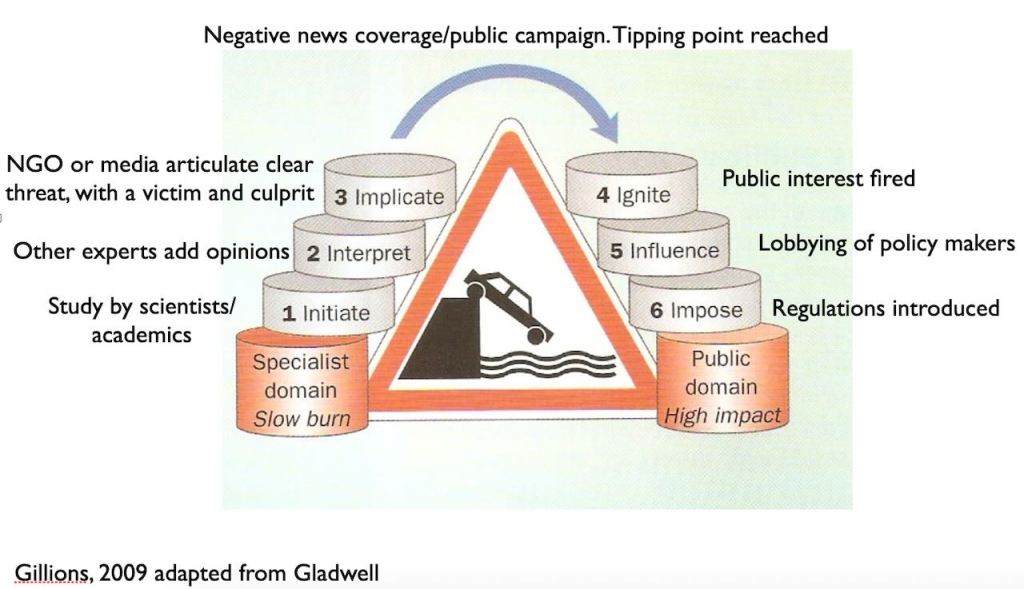
Can Gladwell’s ‘Tipping Point’ help us to understand how a problem can progress from an issue to a crisis? What can activists learn when campaigning on an issue, and what can organisations learn when defending themselves from attack? And – to be topical – does the Post Office/Fujitsu crisis fit this model and indicate what will come next?
In Malcolm Gladwell’s sociology book ‘The Tipping Point’, he defined a tipping point as “the moment of critical mass, the threshold, the boiling point”. He described how ideas, products, and messages spread like viruses. Paul Gillions, a former Managing Director of Burson-Marsteller, adapted the tipping point model. An issue starts slowly in a specialist domain (initiate stage), to which other experts add their opinions (interpret stage) and an NGO or the media articulate a clear threat, with a victim and a culprit (implicate stage). The issue slowly goes up the steep hill until it reaches the threshold. That is when negative news coverage or a public campaign tip it over the top into the public domain. The issue becomes a crisis as it gathers momentum and public interest is fired (ignite stage). As the crisis goes on, there is lobbying of policymakers (influence stage), and eventually, regulations are introduced (impose stage).
Activists can help their cause by persuading experts to add their voices to an issue and gain news media coverage to fire up public interest. Then, the issue reaches the tipping point and turns into a crisis. The organisation being blamed has to respond. They will probably be on the defensive. That organisation would have been better off keeping the issue on the slow-burn side by proactively managing stakeholder relations so that it didn’t reach the tipping point.
The Post Office and Fujitsu Horizon problem was an issue for twenty or so years. When introducing the accounting software, Fujitsu IT trainers knew there were problems with it. Expert journalists at Computer Weekly reported on the problems. A specialist consultancy told the Post Office about the faults in the software. However, the Post Office decided to ignore this. Private Eye magazine articulated the culprits and victims as the aggressive prosecution of 700 sub-postmasters took place. Alan Bates mounted an excellent campaign over many years without the resources many NGOs enjoy. The recent ITV drama ‘Mr Bates vs the Post Office’ was the tipping point. Public interest was fired up. I know of people who were throwing things at their TVs in anger! There is now considerable lobbying by organisations like 38 Degrees and their many supporters for justice for the sub-postmasters and punishment for the culprits. The government may well introduce legislation, particularly to limit the opportunity that big business has to bring private prosecutions. The crisis may be reaching the bottom of the hill. Public interest may well wane. But the repetitional damage (and financial cost soon) to the Post Office and Fujitsu is enormous.
[Image: author]



 Bite Size Comms
Leave a comment