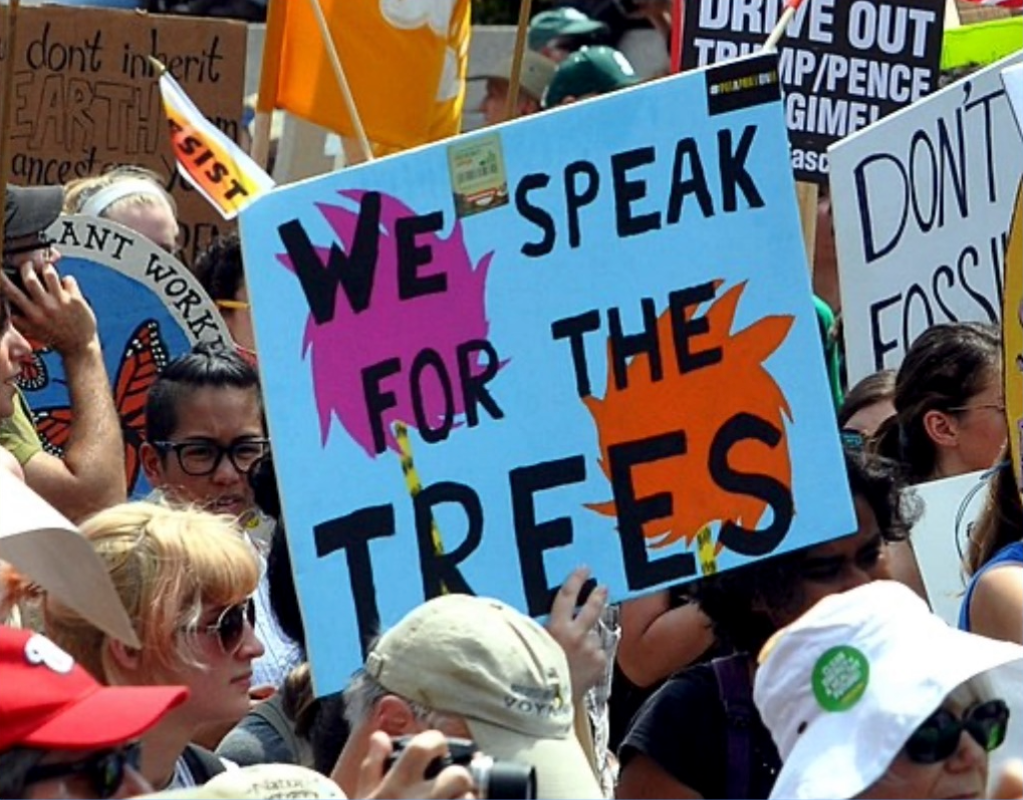
“I am the Lorax, and I speak for the trees”. My nine-year-old has been going around the house saying this phrase. I had to find out what bit of modern YouTube culture this was from. In fact, it is a story written in 1971 by the children’s book author Dr. Seuss. It is a fable about the danger of greed causing human destruction of the natural environment. The story goes that the Onceler found a particular tree, the Truffula, that made an excellent Thneed. The Onceler’s small business soon grew into a large Thneed factory. He cut down the Truffulas to create an even greater profit. In doing that, he contaminated the water supply and polluted the air, causing distress to animals and birds who all left. The environmental activist character is the Lorax. He said, “Unless someone like you cares a whole awful lot, nothing is going to get better, it’s not”.
It is a brilliant piece of storytelling about climate change. It was Dr. Seuss’s personal favourite of his books. It is now mine.
The Lorax was written 50 years ago. Why have we not succeeded in communicating the dangers of climate change, to reduce humans’ harmful impact on the environment? One of the problems was letting the scientists write the narrative. The scientists have an important role. It is not in communicating the issue. The narrative has become full of data and technical terms. Does any non-scientist really understand ‘Carbon neutral by 2050’? We have also employed a scare narrative that might sound attractive to some people. ‘The Earth will be 1 degree warmer by 2030’. That might sound welcoming to someone in the middle of a cold winter or wet summer in Britain. Data about long-term projections, 2050 or even 2030, can’t be visualised by many people. It is easy to say that a technological solution will be invented in due course, with no need to do anything now. We have lost the plot of good storytelling. Where are the people, animals, and characters in those narratives? Dr. Seuss knew how to communicate an issue he believed strongly in.
In their excellent guide to communicating climate change, ‘Sell the Sizzle’, Futerra cited the US sales consultant Elmer Wheeler, who in the 1950s advised businesses, “Don’t sell the sausage – sell the sizzle”. Elmer understood that the sausage contents wouldn’t promote the product. It was the thought of sizzling sausages on a barbecue: the smell, the noise and the feeling of hunger! For years, we have sold the science of climate change. The narrative is that we will all die unless we do something. We need to find the sizzle. We need to build a vision of a sustainable world. Something that people can visualise – build a picture of it in their mind. It needs to be local so that people can relate to it. It needs to be desirable. Cut the dates, figures and targets. Those form the plan, not the narrative. Give people the choice between doing something now to protect the environment or carrying on as before. The two sides to a story that journalists use when reporting an issue. The language of our narrative should fit the audience; people must have the agency to act. An “I Have a Dream” speech about the climate emergency. Using words, pictures, stories and lived experience.
According to Futerra’s ‘Stories to Save the World’, three story frames have emerged against the climate doom narrative. The first is of youth mutiny, as set out in Suzanne Collins’s Hunger Games or the activism of Greta Thunberg. Second is the idea that a rich techno-bro will save us with a technological solution. Third is values change, discarding the over-consumption and exploitation of climate-destroying capitalism. However, each frame will appeal to a particular group of people and possibly even alienate other groups. Futerra argues that we need new story frames. Flip the script from fear to hope, rage to purpose, confusion to confidence, guilt to pride, apathy to motivation. And logic to magic, using emotionally intense stories that humanise climate action.
There is hope at the end of The Lorax. The Onceler understood what the Lorax meant about caring and gave a boy the last Truffula seed and urged him to grow a forest from it, hoping that the Lorax and the animals and birds would return. We must move from the ‘We’re doomed’ narrative (with apologies to Private Frazer in Dad’s Army) to ‘A sustainable future looks like this’. As professional communicators who know how to change people’s opinions, attitudes, feelings and behaviours, we must also do our bit. That’s the story-telling challenge, fellow communicators.
[Image: Wikimedia Commons]



 Bite Size Comms
Leave a comment