If you read my “Oscars speech” a month ago, after being awarded the Independent Impact 50 award, you will know that I didn’t go to university and instead jumped at opportunities throughout my (so far) 46-year working life. The days when “falling into PR” was a perfectly acceptable career narrative are giving way to a more structured and strategic one. At the heart of that transformation is the question of professional qualifications, and the Chartered Institute of Public Relations (CIPR) sits at the centre of the answer. I gained the CIPR Diploma 16 years ago, and I’m proud of that accomplishment. Whether you are three years into your career or thirty, there is a compelling case for pursuing CIPR qualifications. That case rests not only on career pragmatism but also on what it means to be part of a genuine profession.
What’s in it for you?
The individual benefits are well evidenced. CIPR’s own research shows that those with professional qualifications command higher salaries than their non-qualified counterparts, and that Chartered status is associated with a salary premium of around £17,000. But the financial reward is almost a secondary consideration compared with what practitioners consistently report as the most significant benefit: confidence.
Many of us built our PR careers by learning on the job and developing instincts. A CIPR qualification grounds experiential knowledge in theory. As one Diploma graduate put it: “Understanding theory has enabled me to build a framework of wider understanding that has been transformative in the work I now do.” The ability to articulate why a strategy will work, not merely that it has worked before, is a quiet yet powerful professional asset. It changes how you perform in work situations, such as meetings or presentations.
Research by the PR Academy in 2023 found that 94% of practitioners endorsed the value of professional qualifications in developing capabilities while working in PR. Unlike many forms of professional development, CIPR qualifications are designed to be applied immediately, as the work-based assessments mean your employer benefits from day one.
What’s in it for your organisation?
The organisational case for CIPR qualifications is increasingly hard for communications directors and HR leads to ignore. Qualified practitioners bring deeper learning than tactical training alone, what academics call “deep-level learning”: the ability to understand evidence-based frameworks, to critically evaluate options, and to adapt strategy rather than simply repeat it.
For agencies and consultancies, a qualified team is a tangible competitive advantage and signals to clients that the business operates to the highest professional standards. For in-house teams, supporting staff in achieving CIPR qualifications demonstrates an investment in people and gives stakeholders confidence that the organisation’s reputation is being managed with rigour and accountability.
There is also a practical case for crisis resilience. Practitioners with formal qualifications in ethics and strategic communications are better equipped to navigate the complex situations that define reputational risk. Knowing the frameworks matters when the stakes are high.
What’s in it for society?
This is perhaps the least discussed dimension and arguably the most important.
Academic research on the sociology of professions, from Eliot Freidson’s foundational work onwards, identifies qualifications, ethical frameworks, and professional associations as the pillars distinguishing a true profession from an occupation. Public relations, as commentator Stephen Waddington has argued, still has work to do to fully realise that status. CIPR qualifications are a core part of the mechanism through which that gap closes.
The stakes are societal. In an era of misinformation and institutional distrust, qualified PR practitioners serve as a kind of ethical infrastructure. Research published in the Public Relations Review has examined how PR professionalism is linked to social capital and democratic functioning, identifying education, ethical standards, and professional associations as key dimensions of that relationship. Put simply: when communicators operate to a common ethical standard, grounded in shared knowledge and accountable to a professional body, public life works better.
The CIPR’s own Chartered purpose is explicit on this point: it exists “to promote for the public benefit high levels of skill, knowledge, competence” in public relations. Its Code of Conduct, signed by all members, creates accountability not only to employers and clients but also to the public. Studies of professional ethics codes across international PR associations confirm that loyalty to clients is subordinated to public and social responsibility, a principle that qualified, committed practitioners are best placed to uphold.
The bigger picture
The CIPR’s 2024 State of the Profession report, which drew on a survey of over 2,000 practitioners, revealed challenges posed by AI, fake news and disinformation, the expanding skill set required of individual practitioners, and a lack of analytical skills, collective self-belief and confidence. In that context, the case for structured, theoretically rigorous professional development is stronger, not weaker.
If you are weighing up whether a CIPR qualification is worth your time and money, consider this: the question is not only what it does for your career, but also what it does for the profession and for the people that profession ultimately serves.
Disclosure: I am a member of the CIPR and tutor PR qualifications at Cambridge Marketing College.
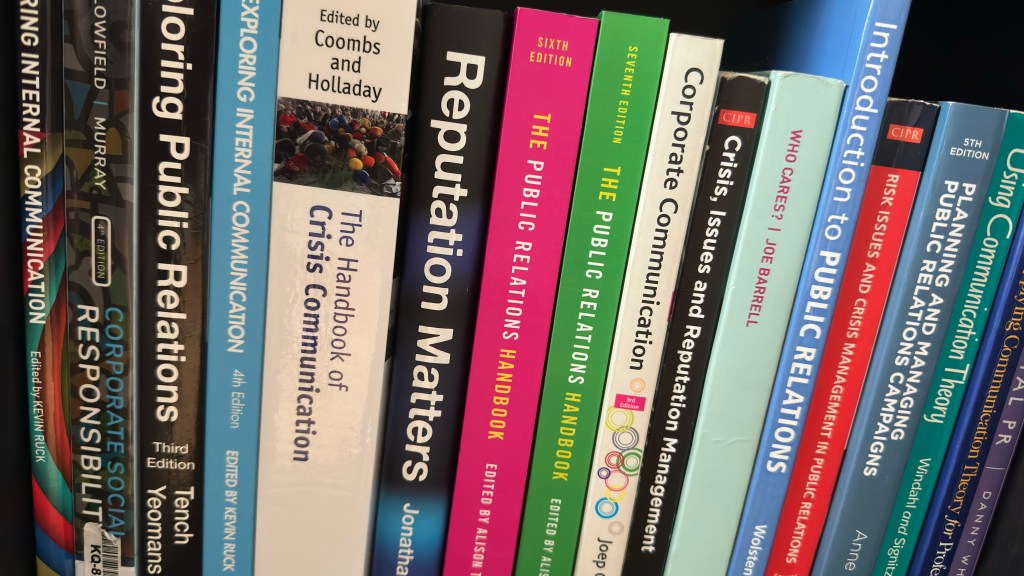
[Image of public relations books on shelf]



 Bite Size Comms
Leave a comment